


Measurement & Testing Equipment and
Automation Solutions Provider
Introduction
Jiangsu Zhongke Junda has established a comprehensive quality management system covering the entire product lifecycle, including R&D, procurement, manufacturing, system integration, engineering delivery, and after-sales service. Through complete internal testing and validation capabilities, standardized inspection procedures, and comprehensive certifications, the company ensures the consistency, reliability, and measurement accuracy of measurement and control systems, laboratory engineering equipment, and smart water IoT terminal products, meeting domestic industry standards and overseas project compliance requirements.
Full-Process Quality
Control System
- 01
IQC Incoming Quality Inspection
Critical components, sensors, circuit boards, and structural parts undergo incoming inspection before production. Key materials are subject to performance sampling tests, and non-conforming materials are rejected directly to prevent quality risks at the source. - 02
IPQC In-Process Quality Control
Inspection checkpoints are established throughout production processes, including assembly, cabinet wiring, welding, and system integration. Process engineers conduct on-site inspections to ensure standardized manufacturing procedures and maintain complete process records. - 03
FQC Final Product Functional Testing
Each hardware module and complete measurement and control cabinet undergoes comprehensive testing, including power-on testing, communication verification, signal acquisition testing, and functional logic validation. - 04
Burn-in Testing for Complete Systems
Complete systems undergo long-duration continuous operation testing under simulated operating conditions to identify potential hardware stability issues. Large-scale laboratory systems are pre-integrated and commissioned in the factory to verify coordinated operation of the complete system. - 05
OQC Final Outgoing Inspection
Final inspection includes accuracy verification, functional validation, and documentation review. Products can only be shipped after passing inspection and receiving a final test report. - 06
On-Site Acceptance and Quality Traceability
Projects undergo item-by-item acceptance according to technical specifications at the customer site. Product quality records are established to ensure closed-loop issue tracking, with improvement feedback transferred back to R&D and production teams.
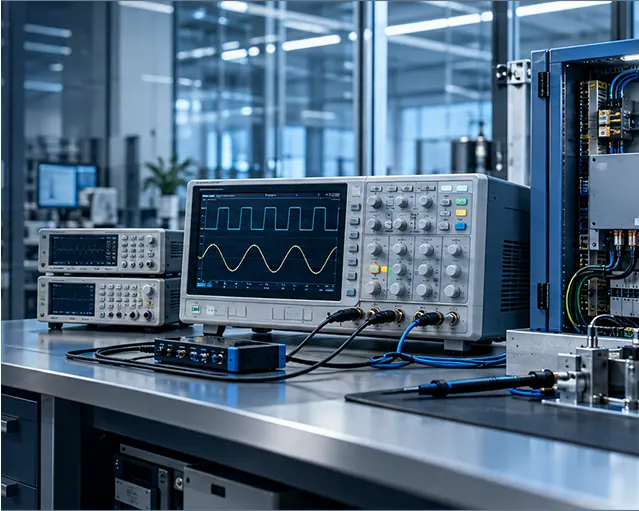
Internal Testing and Validation Capabilities
Relying on its own multi-disciplinary laboratories, the company provides comprehensive validation support for products and engineering projects
- 01Electrical performance, signal accuracy, and multi-channel synchronized acquisition testing;
- 02High and low temperature testing, power consumption testing, and communication reliability testing;
- 03Refrigeration and thermal performance simulation and validation
- 04Acoustic system simulation and actual measurement verification;
- 05Long-term stability and anti-interference testing for IoT terminals.
Management System
Certifications
Environment
Safety
- ISO9001 Quality Management System Certification
- ISO14001 Environmental Management System Certification
- ISO45001 Occupational Health and Safety Management System Certification
- National High-Tech Enterprise
- Municipal-Level Enterprise Technology Center
Product and Export Compliance Certifications
For domestic projects and overseas export business, Zhongke Junda can provide solutions that comply with applicable market requirements:
Domestic
Measurement-related qualifications and water industry product testing reports;Overseas Projects
Compliance testing and certification support based on project requirements, including CE, EMC electromagnetic compatibility, and LVD safety compliance;Home appliance laboratory measurement and control systems
System verification according to international testing standards to support overseas customers’ laboratory certification requirements.
Measurement Calibration Capability
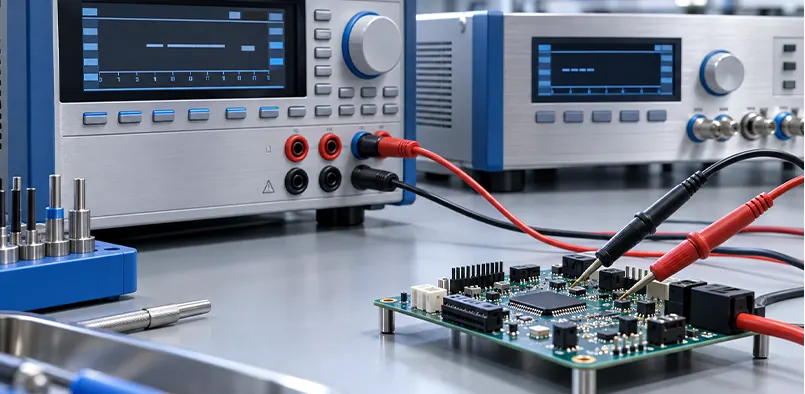
The company is equipped with multiple sets of standard measuring instruments that have been calibrated by external metrology institutions. These instruments are used for accuracy calibration of circuit boards, acquisition modules, and measurement and control systems.
The company maintains instrument records and regularly submits equipment to qualified metrology institutions for verification, ensuring measurement traceability of testing and calibration instruments and guaranteeing the accuracy of measurement and control products.
Continuous Quality Improvement Mechanism
The company maintains a quality issue tracking system, collecting and analyzing issues identified during production, final testing, and on-site project implementation. These issues are fed back to the R&D, process engineering, and procurement departments to establish a closed-loop process of problem analysis → corrective action → verification.
Meanwhile, based on customer technical feedback, the company continuously improves product processes and software/hardware versions to enhance overall product reliability and performance.